Today’s buildings demand more light, more openness and more flexibility than ever before. These requirements often conflict directly with the inherent characteristics of traditional masonry construction, which relies on various layout requirements to provide strength and stability.
One of the biggest challenges is the widespread desire for larger expanses of glazing. Clients and architects alike favour wide openings to maximise natural light, improve views and create a stronger connection between internal and external spaces. While aesthetically appealing, these large openings significantly reduce the width of stabilising masonry panels, limiting their ability to resist wind loads and provide adequate lateral stability.
As these openings increase in size, what were once robust and effective shear walls are gradually broken down into much narrower elements. These slender strips of brickwork have a dramatically reduced capacity to resist lateral forces, making them structurally inefficient. In many cases, this necessitates the introduction of steel portal frames or other structural interventions to reinstate the lost strength and stiffness that the masonry would previously have provided.
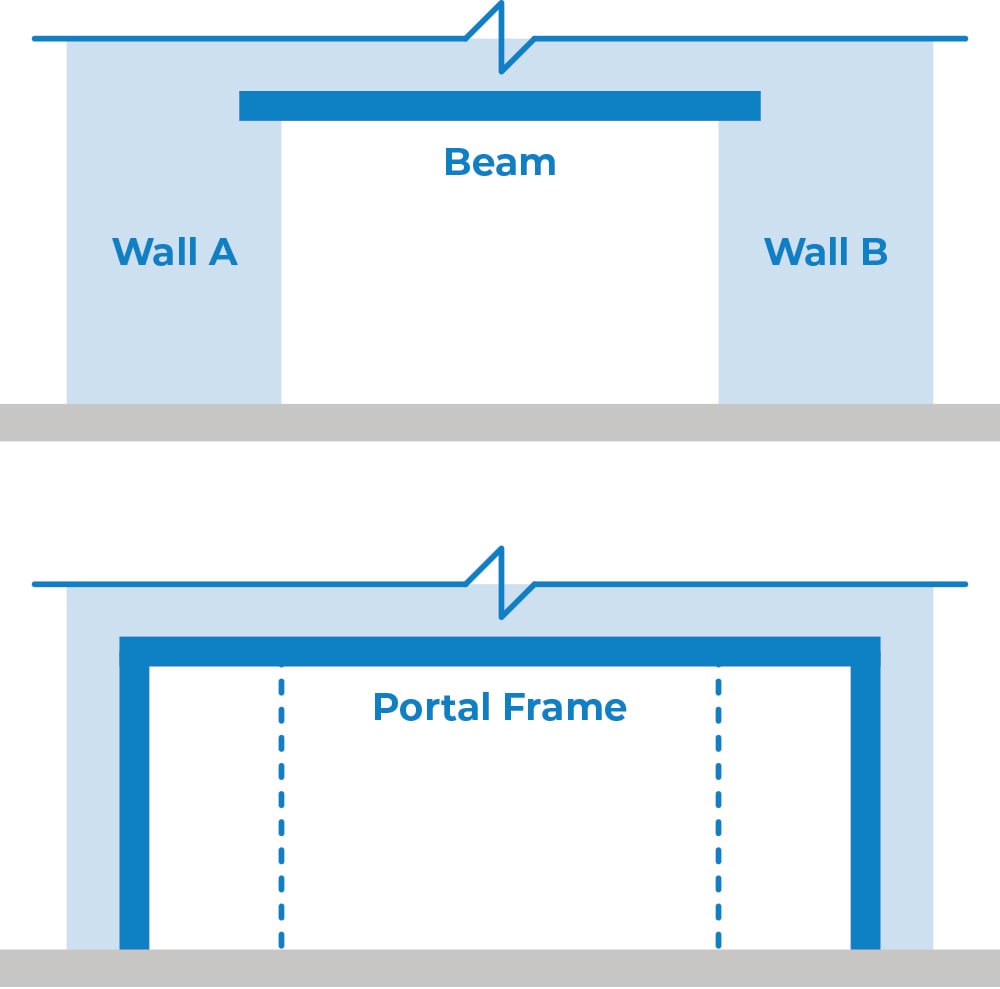
Top Elevation: Walls A & B are sufficient to provide lateral stability.
Bottom Elevation: The opening is enlarged; Walls A & B are too narrow and, therefore, a portal frame is required.
Closely linked to this issue is the increasing prevalence of small masonry panels between openings. As window and door sizes grow, the remaining piers of masonry become narrower and more slender. These narrow elements are often unable to perform adequately under wind loading without additional support.
To compensate, designers frequently need to introduce reinforcement in the form of windposts, steel columns or other stiffening elements. While effective, these additions introduce a level of complexity that runs counter to one of masonry’s traditional strengths: its simplicity. What was once a straightforward construction method becomes a hybrid solution requiring careful coordination between trades, tighter tolerances and more detailed design input.
This added complexity also brings increased cost, both in terms of materials and labour, as well as greater potential for construction challenges on site. The cumulative effect is that masonry begins to lose its competitive edge as a simple and economical structural solution.
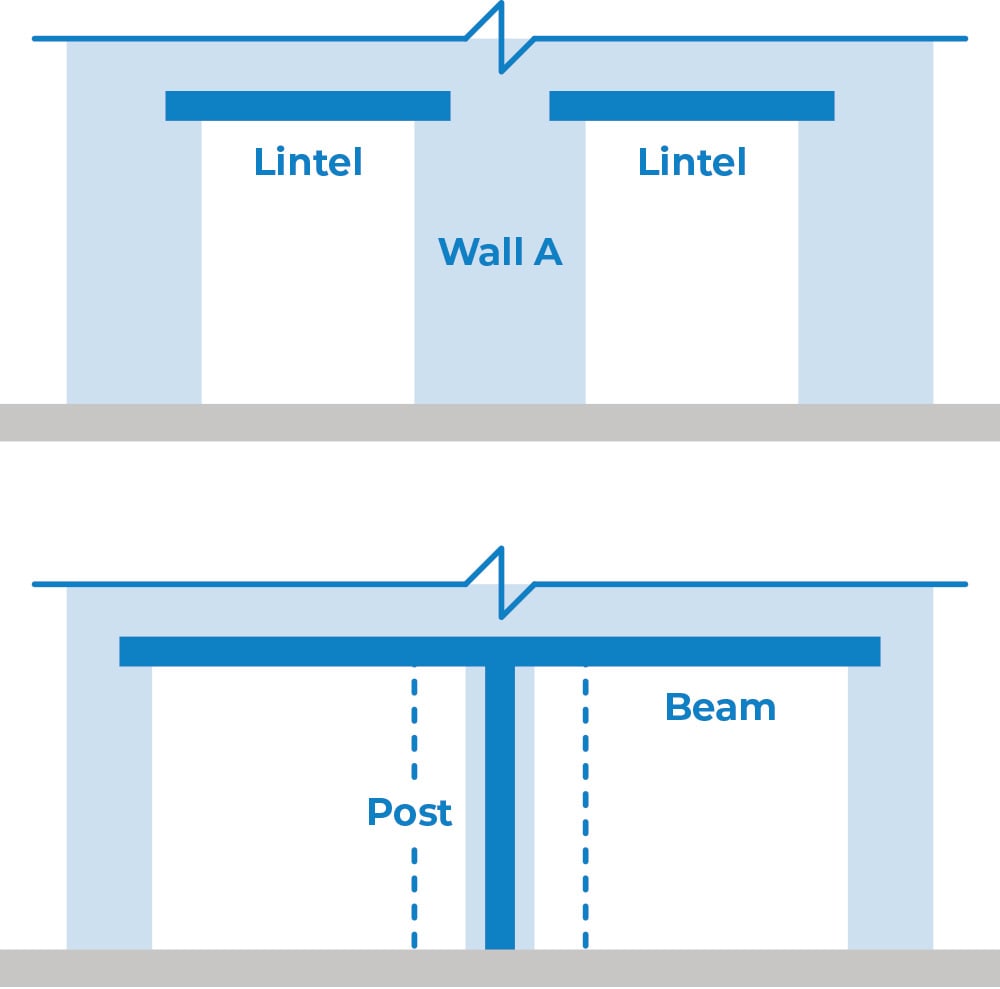
Top Elevation: Wall A is sufficiently stable.
Bottom Elevation: The openings are enlarged; Wall A becomes too slender and, therefore, a post is required to provide stability.
Another important factor is the modern preference for open-plan internal layouts. Contemporary living spaces often eliminate internal partitions and cross-walls in favour of large, flexible areas. While this enhances usability and spatial quality, it removes the internal buttressing that masonry structures have historically relied upon.
In traditional layouts, internal walls provide critical lateral support to external masonry panels, effectively reducing their unsupported height and increasing their stability. When these internal supports are removed, the external walls are required to span greater distances without intermediate restraint. This can result in panels that are simply too large or too slender to remain stable under wind loading.
As a consequence, additional elements such as windposts or structural frames are again required to compensate for the loss of internal support. This further reinforces the shift away from pure load-bearing masonry towards more complex, composite structural systems.
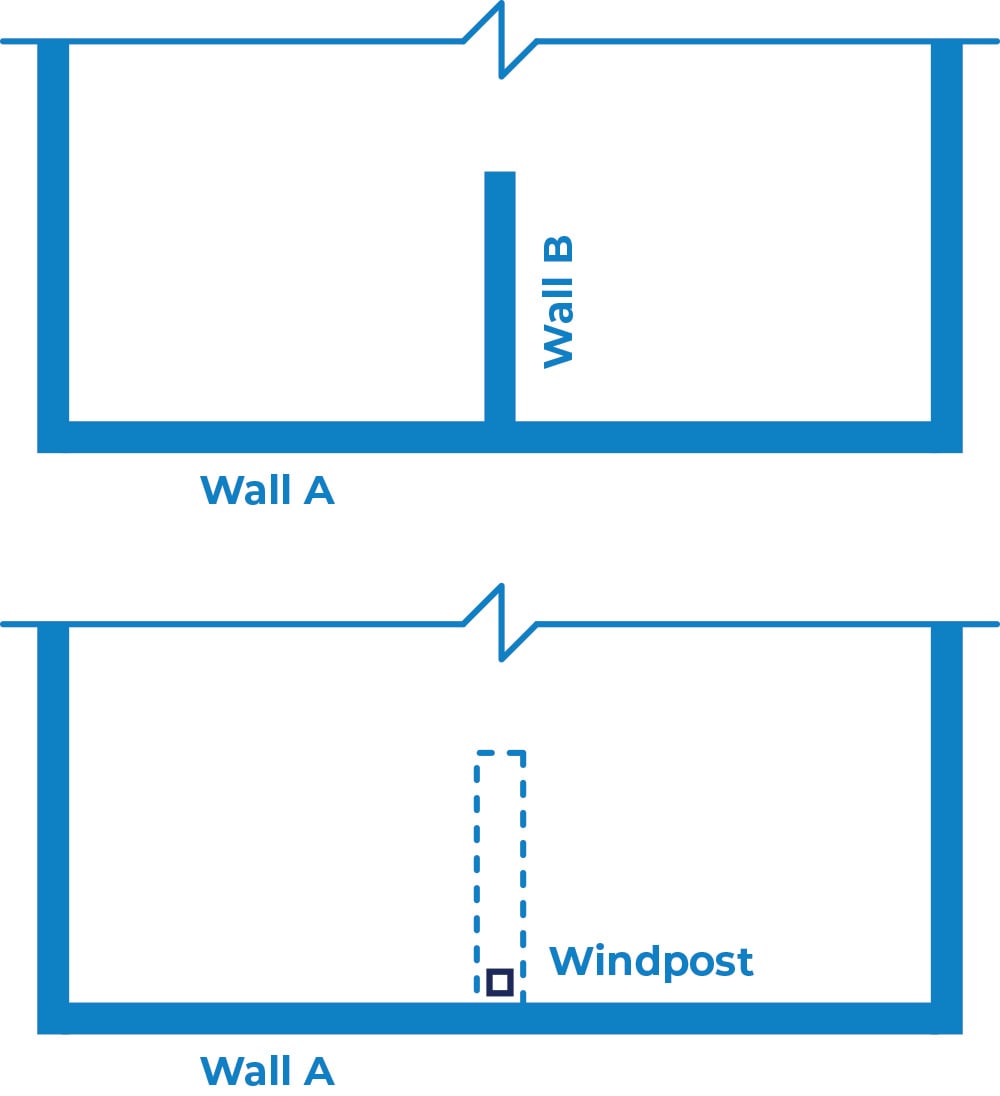
Top Plan: Wall B is sufficiently buttressing Wall A.
Bottom Plan: Wall B is removed; therefore, Wall A now fails due to wind loading. A wind post is required.
When all of these factors are considered together—larger openings, slender piers, reduced internal support and increased reliance on supplementary steelwork—it becomes clear that the practicality of load-bearing masonry is being stretched. In many modern schemes, the level of intervention required to make masonry work can outweigh its original benefits.
For new structures, particularly those with ambitious architectural requirements, it is therefore easy to see why an entirely steel-framed solution may emerge as the most logical and efficient option. Steel framing offers greater flexibility in accommodating large openings, open-plan layouts and complex geometries, often with more predictable performance and coordination.
None of this suggests that load-bearing masonry no longer has a place in modern construction. Far from it—it remains a valuable and appropriate solution in many contexts. However, it does mean that it must be used with a clear understanding of its limitations and with careful consideration of the overall building design.
Early structural input is essential. By engaging with engineers at the concept stage, it is possible to strike the right balance between architectural ambition and structural efficiency. This ensures that stability, economy and buildability are all achieved, even within today’s more open, glazed and flexible building designs.